
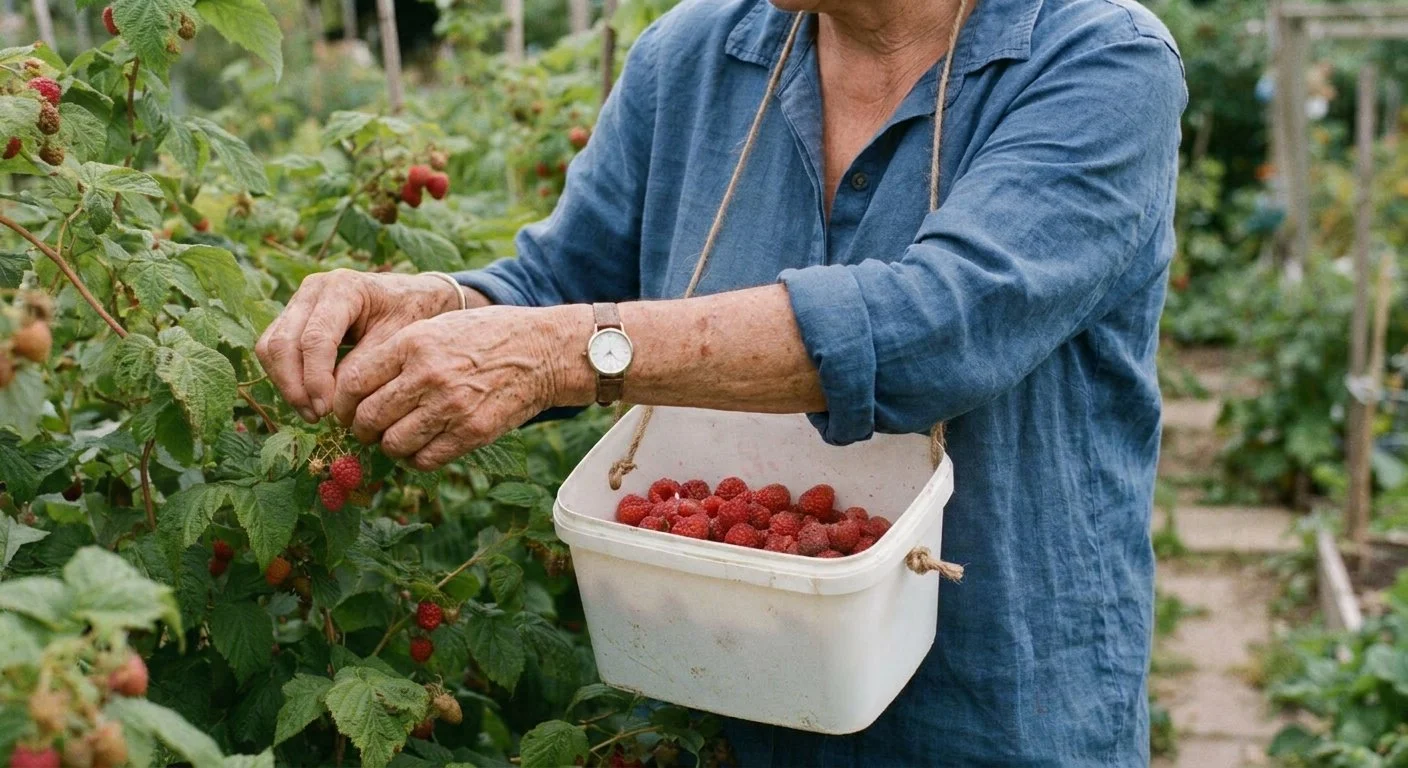
📷 Made with Nano Banana (AI). Sadly I don’t have a photo of Grannie and the real tub.
An old margarine tub, two holes either side just under the rim, thread a piece of string through and hang it round your neck. Voilà! Hands free raspberry picking - it helps when you are in your late 80s.
It was my Grannie’s design. She grew raspberries every year, and as she got less steady on her feet, holding a tub while keeping her balance needed two hands she no longer had spare. So she made a tub that didn’t need holding.
The tub came from a tall tower of them she kept, saved for storing things, sending baking to people and freezing spare soups and stews. Her kitchen cupboards were lined with old coffee jars, neatly labelled for dry goods. Vegetable peelings went into a stock, then onto the compost heap, and last year’s heap was where this year’s courgettes went in. Some of the best courgettes I’ve ever tasted.
She came from a poor family, served in the war and lived through the years of rationing and scarcity that followed. Throwing things away and wasting resources wasn’t how she’d been brought up.
She was also a socially responsible entrepreneur long before anyone used the phrase, and she’s a big part of why Ellipsis Coaching exists.
She lost a good cleaner
A few years ago I sat in a busy pub in Glasgow, the night before my youngest sister’s wedding, next to the woman who had become her godmother. She told me she’d always be in debt to my Grannie.
She’d started out as Grannie’s cleaner, a few hours a week. Grannie ran a busy employment agency from her home, and somewhat unconventionally an hour before lunch the CEO would down tools and go and make soup or a salad for the whole team. Everyone ate together, along with any family who happened to be about. That included the cleaner. In Grannie’s house, nobody was ‘just’ the cleaner.
Grannie soon worked out she had a smart young woman on her hands. She’d left school early, had very few qualifications, her confidence was very low and she believed cleaning was all she could do. So Grannie started exploring the idea of going back to college: what she might study, where, and what doors it could open. Running the agency, she knew exactly which doors.
After her studies she came back, and Grannie found her work that paid better and stretched her. Her confidence kept growing.
“If your Grannie hadn’t believed in me,” she said, “I would never have gone back to college, and I wouldn’t be where I am now.”
Grannie lost a really good cleaner. But she couldn’t bear to see human talent wasted, and she’d seen it in her young, unconfident cleaner.
Not just materials
Grannie never called any of this sustainability. It was just how you lived. But it sits close to what we now call a regenerative business: one that puts back more than it takes.
Most of that conversation is about materials. Packaging, supply chains, carbon. All of it matters. But Grannie’s thrift didn’t stop at margarine tubs. People weren’t something to use up either, and that included the woman who cleaned her floors.
A business that recycles everything and burns through its people hasn’t closed the circle. And the first person most founders use up is themselves.
Starting with you
A client I worked with this year has built her business around caring for carers. She knows burnout in caring work inside out. She’s studied it, and she’s seen what it does to the people she wants to support.
She was also living it. To keep money coming in, she was picking up shifts in the same kind of caring work that wears people down. The shifts paid the bills, but they left her almost no time to think, rest or build the business she was there to build. She could see she couldn’t keep filling her time with things that left her none.
Part of what kept her there was an assumption that work she loves and a fair wage pull in opposite directions, so choosing one meant giving up the other.
When we got underneath it, her big, sprawling vision came down to one small number. “All I need in the next six months is two more clients.” Two clients in her business meant fewer shifts, and fewer shifts meant the space she’d been missing…
Work she loves and a fair wage could sit together. It started with treating her own time and energy as something worth fiercely protecting.
The people you lead
In my first full-time teaching job, my head teacher was a good mix of scary and inspirational. She made a point of being one of the first cars out of the staff car park at the end of the day. I doubt she really stopped working at 4.30pm, but she was setting an example. She wanted us happy, healthy and high performing, and she didn’t want long hours and burnout to become the norm.
She also found us a day. With some clever timetabling and the team’s agreement, we did our training hours across a few later evenings in the autumn term, which earned us a day back at the end of November. She called it our Christmas shopping day, and we weren’t to tell other schools. Teachers never get a weekday off in term time. By late November you’re limping towards the end of the longest term, energy is low and staff sickness is high. One day to recharge meant the whole team reached the end of term in much better shape.
The next head I worked under was usually one of the first into the car park and one of the last out, working 7am to 7 or 8pm. His staff understood that was expected of them too. Support was thin, competition was unhealthy and burnout was the culture. I lasted nine months. After I left, my job had to be advertised as three full-time roles.
He lost a high-performing head of department. I had boundaries, and I wasn’t prepared to stay in a place built to use people up. Grannie lost her cleaner by helping her grow. He lost me because nobody could have sustained the role he’d created.
The people beyond
An artist and educator I worked with as a client started a project from a single image: a group of people outdoors who had made something together from the land, with nothing material left behind once they’d gone.
The project grew from there. She wants to show young people, and others who’ve fallen out of the mainstream, that there’s a route back in. In her words: “Not reductive, not wishy-washy, strong, with allies.” Working with the land in a regenerative way is a well-walked path that doesn’t shout. She’s shining a light on it.
It’s Grannie’s cleaner again: people the system has written off, shown there’s more for them.
There was a catch. She was much better at keeping promises to other people than to herself. Paid work and her children always came first, and the time she set aside for her own project was the first thing to go.
So we looked at how she decides what to say yes to. Her test became whether something nourishes her. A trip to see a friend’s show and a weekend camping were both hard to organise, and both fed her and the children.
That’s when she said something she asked me to write down: “You need to be a whole person to be a good parent.” If you wrap your whole life around your children, what they learn from you is sacrifice.
It holds even if you aren’t a parent. You need to be a whole person to be a good partner, friend, boss or co-founder.
That includes running a business for good. Give up everything of yourself to build it, and sacrifice is what you teach the people around you. It’s also a price nobody can keep paying.
Closing the circle
Grannie’s cleaner went on to a senior role, then helped her own daughter through a degree and into work. Years later she was still telling the story, in a busy pub the night before a wedding.
When a person isn’t wasted, the good keeps going, well past the place it started.
Grannie lost a good cleaner. What she gained is harder to measure, and it hasn’t stopped.
Most of the founders I work with think hard about what their business takes from the planet. Fewer look at what it takes from people, and fewest of all at what it takes from them.
So here’s my question. What in your business is being used up? And is it you?