
There is always more to your story...
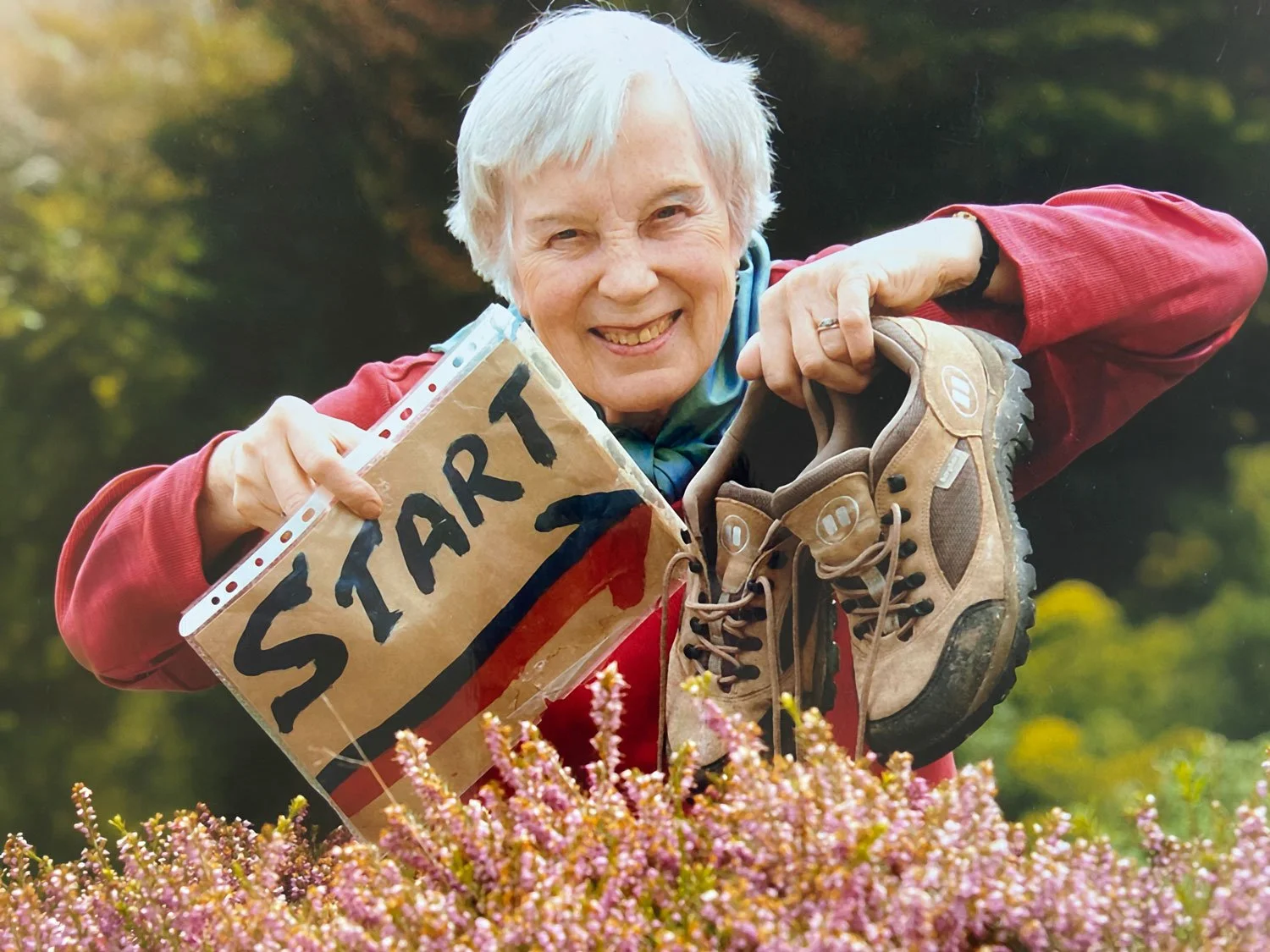
📷 Mabs Paget - entrepreneur, MBE, and the first socially responsible businesswoman I ever knew. Still starting things in her eighties.
In her early eighties an entrepreneur called Mabs Paget sold her business: Haywards Agency.
She was also my Grannie.
She'd built it from scratch in her home - a secretarial and staffing agency in North Wales - and for decades she ran it in a way that went far beyond what was on the tin. The women who came to her weren't just looking for work placements. They were leaving difficult marriages, starting over with no employment history, trying to figure out how to earn a living and raise children in a world that wasn't set up to help them do both. Grannie saw them. She figured out their skills often before they could see them themselves. She sent them off to college. She gave them chances nobody else would.
Her positive impact rippled out across the community for years.
When she was 99 and the family had to find her a nursing home, we walked through the doors of one of the best local places. The woman on reception looked up and broke into a smile.
One of Grannie's 'girls'. She'd helped her get a job many years ago.
There were two more of her girls working in the building.
Growing up and visiting Grannie we'd meet her 'girls' about in her house. Some worked in the office she had there. Some were in for interviews and meetings. Grannie would pause in the middle of the working day to cook everyone lunch. Not just family, but all her team and anyone else who was about. An unconventional move for the CEO, but it speaks a lot of her values of equality, care and connection.
She lived to 102 and a half. She received an MBE from the Queen for her services to charity. And I believe that a significant part of what kept her going that long was having a very clear sense of purpose throughout her life.
She was the first socially responsible entrepreneur I ever knew. And she handed me a blueprint I'm still following.
Being a socially responsible entrepreneur
I didn't know that's what it was called then.
I just knew, from watching Grannie, that it was possible to build something that made money and mattered. That the two weren't in opposition. That you could run a business and leave people better than you found them.
I grew up in the rural north-east of Scotland, the eldest of three daughters. I started my first business at six - selling my handmade coin purses and hair bands to my classmates for 20p until my mother found out and shut me down. I worked market stalls in all weathers as a teenager. I did strawberry picking, waitressing, babysitting, sold my artwork, whatever it took. I saved over three years to get myself to Glasgow School of Art, because my Grandpa offered to match every penny I saved and I took that as a serious challenge.
Money meant freedom and choice to me. Always had.
What I couldn't name then as an entrepreneurial teenager - and only understand now - is that I was also an undiagnosed dyslexic navigating a school system that had no idea what to do with me. I was clearly very able. I spotted patterns fast, asked good questions, saw connections other people missed. But I couldn't memorise a formula to save my life. The system kept telling me to try harder. I kept trying harder and my efforts did nothing. And somewhere in that frustration, I started bunking school, opting out and finding my own measures of success - which took me to some interesting places, and some less healthy ones too.
The resourcefulness I had from an early age wasn't accidental. It came from having to figure things out. It was modelled to me by a long line of independent women who built things - in my family, running your own business was just what you did.
Climbing ladders and burning out
I spent my twenties and thirties doing what a lot of us do.
I retrained. I moved cities. I climbed ladders that looked right from the outside but felt hollow once I got there. Post-production in Soho. A design business. Crime diversion work in Brixton with young people the system had written off. Teaching in some challenging schools, colleges and areas in and around London. An accelerated leadership career and building a strong reputation. I wanted to see what was broken from the inside and if I could be a part of the solution. Bring something different to a system that hadn't entirely worked for me. At every stage I was capable. At every stage I cared. And at several stages I burned out.
The worst of it was in education - taking on my first toxic team in a toxic organisation, holding my breath so hard I started feeling dizzy each day from the tension. Literally. My doctor ran tests. Nothing physically wrong. I was just so caught up in fighting a system and a culture much bigger than me, that I'd stopped breathing properly.
I took a little time off. Came back. Nothing had changed on the outside.
That's the thing nobody tells you about burnout. The external circumstances are still exactly where you left them.
I kept going. Kept iterating. I retrained as a surface pattern designer and spent five years trying to build something of my own while still working in a job that was taking everything I had. I navigated significant personal losses. I was isolated. I was fighting on too many fronts at once.
And somewhere in all of that, a colleague sat across from me at the end of twelve weeks of coaching work I'd done for fun, and he said: "In these twelve weeks I've learnt more and made more progress with you than in twelve years of leadership training. You are a super coach. Why are you not doing this more?"
Good question…
Good questions
That question opened something.
I'd been using coaching quietly for over a decade - using it as a leader, a manager, a mentor. Asking the questions that helped people move. Listening for what was being said and not said. Joining the dots. I was good at it. I'd just never named it or seriously considered it as a thing I could build a business around. Until that question.
So I did.
I retrained, broadening my tools, with one of the best coaching schools in the world. I started building something with intention; a new business. And I knew, almost immediately, what I wanted to call it.
Ellipsis…
The three dots. The punctuation mark that means: there is more. This is not the end of the sentence. There is always another chapter.
I'd been carrying that idea as a personal motif for years by then - I even have it tattooed on my arm, a reminder I got at 35 when my ten-year relationship ended unexpectedly and my life looked nothing like I thought it was going to. The three dots helped me then. They've helped me every time I've had to start again.
In 2021 my husband and I finally made a move we'd been trying to make for years - leaving the South of England and heading north to rural Moray in Scotland. We were homeless briefly. For a term I flew up and down the country to see my students through their exams before I could fully let go. We moved into a house that had been empty for a while and was more of a project than we'd bargained for.
But I was home. And I could finally build the thing I was here to build.
The business of living a good life
Fifty years in (the business of living a good life) - here's what I've got.
The people I work with - socially responsible entrepreneurs, purpose-driven founders - are some of the most capable, committed, genuinely good people you'll ever meet. They started with a fire in their belly. A mission to do something that actually matters.
And somewhere along the way, that spark started to dim, or maybe even eat itself up.
Not because they stopped caring. Because they care so much - and caring takes everything you have if you don't protect it.
I know this because I've lived it. Not once. Multiple times. Across six businesses, multiple careers, too many restructures and toxic environments to count. I know what it feels like to be doing work that means something and still be running on empty. I know what it costs to keep going when you've got nothing left.
I also know - because my grandmother showed me, because my own story shows me - that there is always more. That hitting the wall isn't the end of the story. That the spark can be reconnected.
That's the work.
If you're a founder who started with a mission and has somehow ended up firefighting, exhausted, wondering where the version of you that began all this went - you're in the right place.
There is always more to your story. The three dots say so…
If any of this resonates, I'd love to hear from you - drop a comment below.
If you'd like to read more like this, I write regularly over on Substack. You can find me at tanyapaget.substack.com